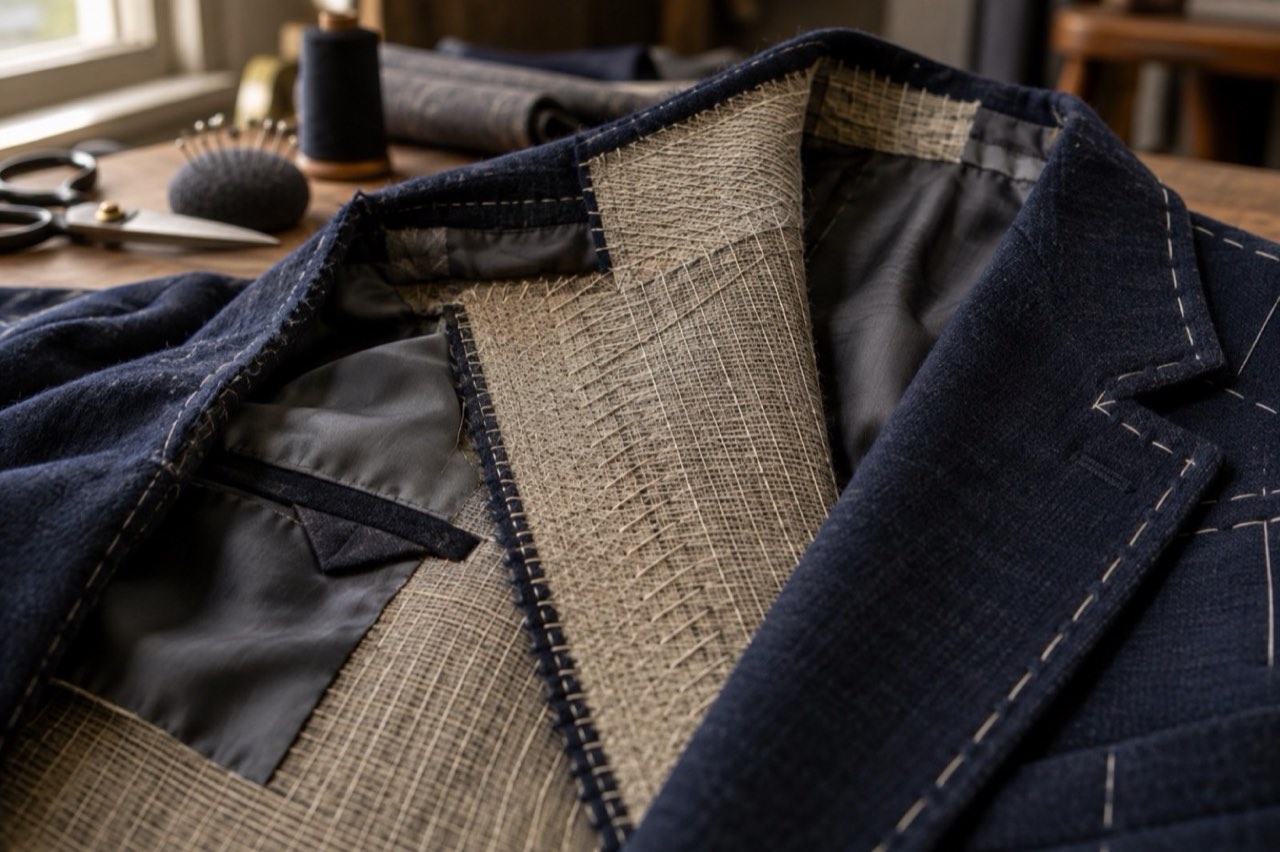
The difference between fused, half canvas and full canvas is what holds the jacket front in shape: a glued interlining, a floating canvas through the chest and lapel, or a canvas that runs the whole length of the front. For a shop selling mill cloth, half canvas is the usual default, and with us it starts at 185 USD per two-piece suit, ex works Shanghai.
Clients tend to ask about this at the counter while holding a swatch with a famous name on it, so below is what to tell them and what to order.
What holds a jacket front in shape
Every structured jacket has something between the outer cloth and the lining that gives the chest its shape and the lapel its roll.
In a fused jacket, a thin interlining is bonded to the cloth with heat and adhesive, and that bonded layer does the shaping.
A half canvas jacket has a floating canvas behind the chest and lapel, sewn in rather than glued, while the lower front is still fused.
In a full canvas jacket the canvas runs from the shoulder down to the hem of the front, and nothing is bonded to the cloth anywhere. We make all three, and you choose per suit, per client.
Fused construction and its limits
A fused jacket comes out clean, light and consistent. The interlining is pressed onto the cloth in one step, so the front holds its shape from the first wear, and of the three builds it costs the least to make.
Where it gives ground is the chest and lapel. A bonded interlining tends to press the lapel flat, so the client loses the curl from collar to top button that a canvassed lapel has, and the chest keeps the shape it was pressed into.
Fused still has its place. For a client who wants a plain worsted for the office and has never once looked at a lapel roll, it is a reasonable build.
Half canvas as the default build
Half canvas puts a floating canvas through the chest and lapel. Below the waist the front is fused.
Your client gets a lapel that rolls in one continuous line from the collar to the top button, and a chest that shapes to him over time because the canvas can move against the cloth.
Half canvas, full package (our cloth, our make), starts at 185 USD per two-piece suit, ex works Shanghai. That is a starting figure. The cloth your client picks sets the final price, so ask us for an exact quote once the cloth and the details are settled.
For most shops selling named mill cloth this is where the build matches the cloth, since your client is already paying for the mill name on the swatch and a canvassed chest and lapel let that cloth drape the way it was woven to.
Full canvas for fine cloth
In a full canvas jacket the canvas carries on from the shoulder through the whole front panel, and no adhesive touches the cloth at any point. It drapes from chest to hem.
This is the build for fine, light cloth you would rather not stiffen with glue, and for the client who notices drape and will tell you about it. We do not list a starting price for full canvas; send us the cloth your client has chosen and we will quote it.
Showing the difference at the counter
Three checks work with a client standing in front of you.
Start with the pinch test: open the jacket and pinch the front just below the top button between thumb and forefinger. In a fused jacket the layers feel like one piece of cloth, while in a canvassed jacket you can feel a third layer between the cloth and the lining, moving on its own.
For the lapel roll, lay a fused jacket and a canvassed one side by side on a table. The canvassed lapel curves and the fused one lies flat.
The third check is the open front. Put the jacket on a dress form and fold the front back; in a half canvas you can see where the canvas stops above the waist, and in a full canvas you can see pad stitching running down the lapel and the whole front. The photos on our pricing page show both.
Matching construction to the cloth
A client who asks for a cloth by mill name is paying for a particular hand, weight and finish, and the build should suit it. For named cloth, half canvas is the floor.
We hold 162 Zegna styles in Shanghai, 99 Trofeo and 63 Traveller. Traveller is a high-twist merino built to recover its shape after packing, and it suits a half canvas business jacket that has to hold its shape through a working week.
The 40 Vitale Barberis Canonico Four Seasons styles we hold take canvas construction cleanly and keep a pressed edge well.
Glue an interlining to cloth like this and you change how it falls. A floating canvas leaves the cloth free to drape, which is the reason your client chose it. Everything we hold is listed on the cloth page, and the Super numbers on those swatches are covered in Super 110s to 150s.
What to do next
Order one half canvas suit in a held cloth as a test. The minimum order is one piece, and production takes 14 days from the confirmed order; shipping time and cost come on top, and you pay import duties at your own rate.
Pick a Zegna Trofeo or a VBC Four Seasons, send us the measurements, and look at the build yourself before you put a client's money into it. Every suit is made in our own workshop in Shanghai, China, and How it works walks through an order from cloth to shipping. When you are ready, message us on WhatsApp or use the form on the contact page.