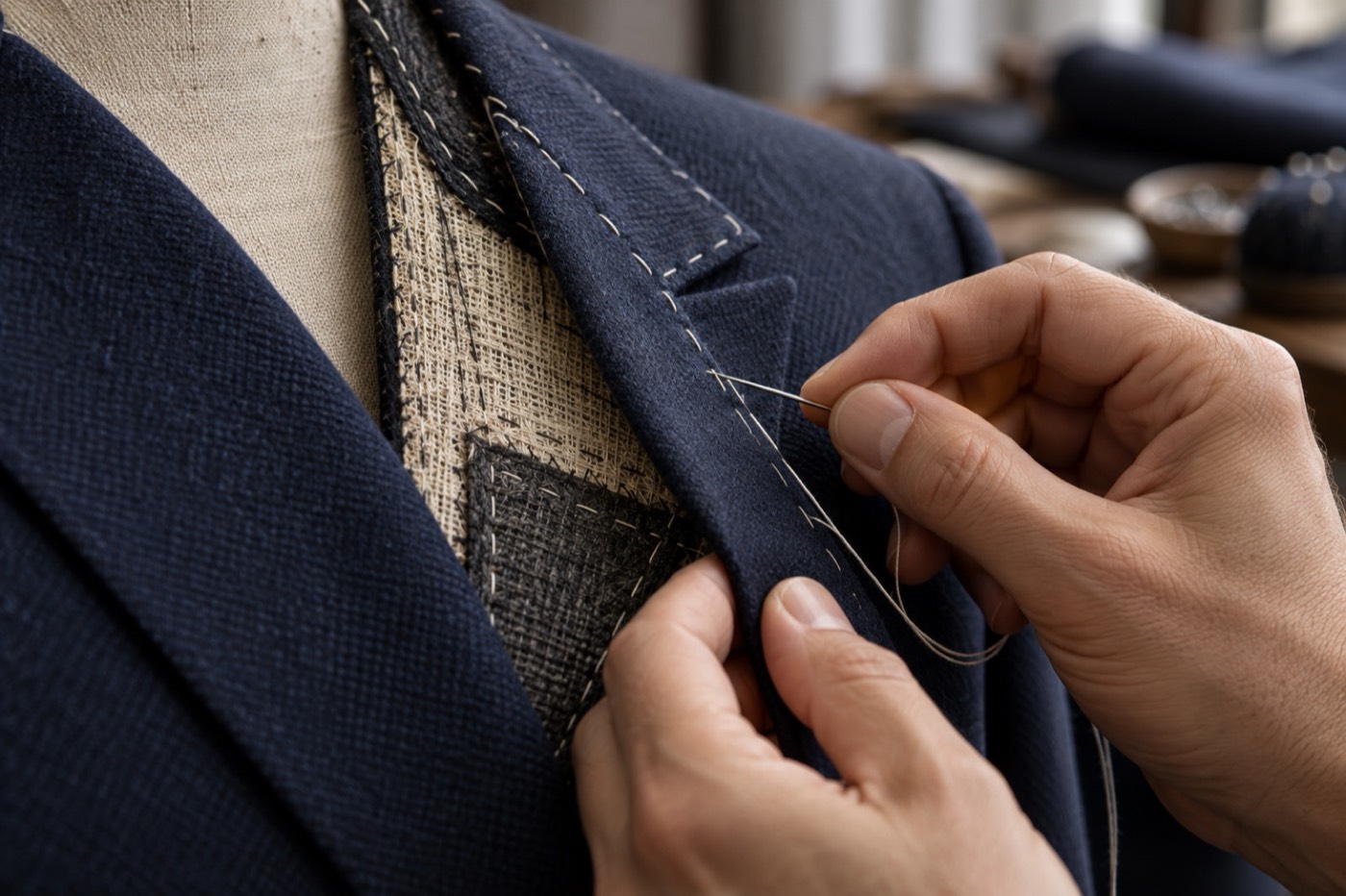
The Super number on a cloth measures one thing, how fine the wool fibre is. It says nothing about weave, weight or how long the suit will last, so a higher number means a softer and more delicate cloth, and it is rarely the right first suit for a client who wears his jacket every week.
What the number measures
Super is a grading of fibre diameter. Super 100s runs at roughly 18.75 microns, and each step of ten is about half a micron finer. Super 130s sits at roughly 17 microns; Super 150s is finer again, closer to 16.
A finer fibre gives a softer hand, and your client will feel the difference the second he touches the swatch. The price of that softness is a more delicate cloth.
What the number does not tell you
Three things a shop needs to know sit outside the Super number.
The first is weave: a twill and a plain weave in the same Super 120s drape and crease differently, and you can see that on the swatch while the label says nothing about it.
The second is weight, a separate figure printed in grams. Our house book, Corsini LANA Four Seasons, is 280 g four-season Australian merino, 100% wool, and that weight tells you what season the suit is for in a way the Super number cannot.
The third is durability, and here a well-chosen Super 110s will often outlast a Super 150s bought for the number on the ticket, because the coarser fibre stands up better to friction at the seat and elbows.
Read the Super number and the weight together.
Super 110s to 130s for everyday suits
This is the working range. The Vitale Barberis Canonico Four Seasons book we hold in Shanghai, 40 styles, runs Super 100s to 130s, and all of it is year-round business suiting meant for a jacket worn every week.
Super 130s is a good pick for a client's everyday suit, fine enough to feel soft on the hand without the fragility of the highest numbers. Start a first suit here.
Super 150s for the occasional suit
Finer fibre is more prone to shine and wear at the seat and elbows when a suit is worn hard, so save Super 150s for the suit that comes out a few times a month, for a board meeting or a wedding.
Do not sell Super 150s or higher as the first suit to a client who wears his jacket five days a week. He will love it in the fitting and be disappointed by the elbows later, and he may never connect that to the number he asked for by name.
Reading a Zegna swatch
We hold 162 Zegna styles in Shanghai, 99 Trofeo and 63 Traveller.
Retailers commonly label Trofeo as Super 130s to 150s. Zegna does not publish an official Super count for the book, so if your client asks, give him the retail label and tell him the mill has not confirmed it.
Traveller does a different job. It is a high-twist merino built to recover its shape after packing and travel, with a drier, less lustrous hand than Trofeo. On this book the twist matters more than the Super number, so lead with the recovery when you show the swatch.
Selling the number at the counter
Before you open a swatch book, ask the client how often he will wear the suit.
If he says every week, or most days, stay in the Super 100s to 130s range and show him the VBC Four Seasons book. The cloth is firm and the price is sensible.
If the answer is a few times a month, open the finer end: Super 150s, the Zegna Trofeo selection, or whatever his budget allows. For a suit that rests between outings, the extra softness is worth the shorter life.
The order that works is the everyday suit first and the finer suit second, once his pattern is proven on a first order and he trusts your judgement.
What to do next
The minimum order is one piece, and production takes 14 days from a confirmed order, plus shipping. Every suit is cut and made in our own workshop in Shanghai, China, whichever mill wove the cloth. If you want swatches of the held books, ask on WhatsApp.
The cloth list has every mill and merchant we cut from, and Half canvas, full canvas, fused covers which build to put a fine cloth into. To start an order, get in touch.